
Hotel Majestic
Lewis Crescent
A family-run kosher hotel that turned post-war survival into seaside hospitality.
Researched and Written by Katie Blythe
Beginnings: From Garwolin to the Seaside
The story of the Majestic Hotel begins long before its doors opened on Lewis Crescent. Its founders, David Schwartzman and Rosie Schwartzman, were among the Jewish families who built new lives in Britain in the early twentieth century.
David Schwartzman was born in 1909 in Garwolin, Poland, arriving in England as a child. Rosie Finkelson, born the same year in London’s East End, grew up in the Yiddish-speaking streets of Whitechapel. They married in Stepney in 1931, settling in a small flat on Newark Street, the heart of Jewish East London.
David Schwartzman worked as a waiter, serving in London’s grand hotels, including the Savoy, while Rosie Schwartzman managed the home. Their son, Arnold Schwartzman, was born in 1936. At nine months old, he slept above his grandfather’s shoe repair shop at 292a Cable Street while the infamous Battle of Cable Street raged in the streets below.
During the Blitz, their Wapping home was destroyed on the first night of bombing, and they were rescued from the rubble. The family was evacuated to Egham, Surrey, where an elderly Scottish couple, the Milnes, took them in. Rosie Schwartzman joined a local munitions factory, while David Schwartzman continued to work at the Savoy.
The trauma of war left a lasting impression on Arnold Schwartzman, whose later work as a designer and filmmaker drew on his instinct to observe, record, and rebuild.

1940 Arnold Schartzman with his parents Rosie and David
Reproduced with the kind permission of Arnold Schwartzman

Arnold, Rose, and David Schwartzman walking along the cliff tops.
Reproduced with the kind permission of Arnold Schwartzman
A New Beginning in Margate
After the war, the Schwartzmans sought a fresh start by the sea. They had honeymooned in Margate and knew it well from David’s pre-war summers as a waiter in the town. In 1946, when Arnold was nine, they moved to Warwick Road, Cliftonville, opening a kosher boarding house called Rosanda, a fusion of their names, Rose and David.
Rosanda quickly flourished among post-war holidaymakers seeking good food and observant hospitality. At the same time, David became manager of the Walpole Bay Hotel, bringing Savoy polish to the seaside. The 1940s were boom years for Margate: the beaches were packed, amusements thrived, and Jewish visitors filled the hotels and boarding houses that lined Cliftonville’s streets.
It was here, in 1950, that the couple’s second child, Diana, was born, a “real Margate baby”, as Arnold later called her.
The Making of the Majestic
Encouraged by their success, the Schwartzmans purchased two adjoining houses on Lewis Crescent, opposite the cliff lift to Walpole Bay. The properties, Kingsthorpe and Carisbrook, were combined to create The Majestic Hotel.
The Majestic stood midway along the Crescent beside Rowden Hall, overlooking the Bourner Memorial Fountain and the greens that sloped toward the Queen’s Promenade. Nearby were the Carmel Hotel, owned by family friend Leon Gradel, and the Granville Court Hotel and Cliftonville Court Hotel. From its terrace, guests could look across the lawns toward Walpole Bay, a view Arnold later called “the two gateways to the sea.”
A few years earlier, the Crescent’s grand houses had served other purposes. Rowden Hall was a Kindertransport hostel before the war, home to Jewish boys rescued from Europe, who were later evacuated inland. During the conflict, it became a New Zealand military hospital, its rotunda walls decorated with cartoon graffiti by convalescent soldiers. By the late 1940s, those same buildings were reborn as family-run hotels, symbols of recovery and optimism.
David and Rosie oversaw the Majestic’s transformation themselves. They knocked through to form a single dining room, opened a broad staircase, and added a covered terrace facing the sea. The Majestic had around 60 rooms. Each was equipped with a washbasin, though the building retained shared bathrooms typical of the era. The décor remained resolutely Edwardian: carved wood, patterned carpets, and velvet curtains, reflecting Rosie’s preference for substance over modern fashion.
Rosie managed bookings with brisk efficiency while David maintained Savoy standards of service. Their blend of warmth and discipline soon made The Majestic one of Cliftonville’s most respected Jewish hotels.

1950 Photograph of the Hotel Majestic
© Margate Local History

Guests outside Majestic Hotel, on the steps
Reproduced with the kind permission of Arnold Schwartzman
For some guests, The Majestic was remembered first through its approach rather than its interior. Beverley Collins, who first stayed there as a child in 1948, recalled “the white steps leading up to the hotel,” a detail that has stayed with her since she was four years old. It was the first hotel she had ever been to.
Community Life
Holiday life in Cliftonville also reflected subtle but well-understood distinctions within the Jewish community itself. Bev Finkeltaub, whose family spent summers in the area, recalled how “different Yiden stayed in different hotels”: her grandparents would always stay at the Majestic, while her parents preferred Highcliffe Hall.
The Majestic sat within a tightly-knit local Jewish community. Other families included the Brooks of the non-kosher Windsor Hall; the Kaye family at the Shalom, where the “frummer frummers” stayed; the Graduses of G’s Stores; the Ruback brothers, one a tailor, the other two plumbers; and Sidney Godfrey of the Harbour Café. The Margate Hebrew Congregation Synagogue on Godwin Road, under Reverend Bernard Landau, was the community’s heart.

1963 photograph - Outside the Majestic Hotel, showing the Star of David on the front.
Reproduced with the kind permission of Arnold Schwartzman
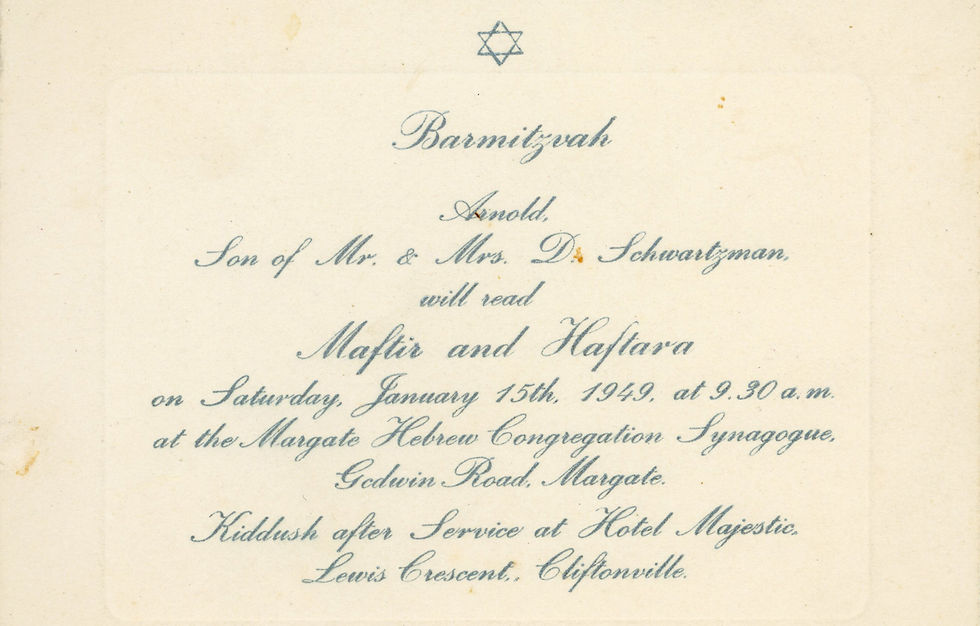
1949 Invitation to Arnold Schwartzman's Bar Mitzvah celebration
Reproduced with the kind permission of Arnold Schwartzman

Arnold celebrated his Bar Mitzvah there in 1949, with the reception, naturally, held at the Majestic. Its dining room hosted countless celebrations, drawing relatives from London and beyond, binding together faith, family, and seaside hospitality.
Inside the hotel, the atmosphere itself became part of guests’ memories: the radiators that ran constantly, “lining your stomach with matzo balls”, the faint cracks in the paintwork, and the comforting flicker of the black-and-white television in the hall. These details, recalled by former guest Tony Graham, now an established theatre director, capture the lived-in warmth of the Majestic as clearly as any photograph.
Former guest Beverley Collins, who stayed at the Majestic throughout her childhood, remembered the hotel through its daily rituals rather than its grandeur. Each morning began with a waitress, possibly called Molly, bringing cups of “lovely strong tea and Nice biscuits” and orange juice to their bedroom, an early comfort before the day began. A shared bathroom lay at the end of the corridor. A gong in the hallway announced mealtimes, kept on a table in the hall just outside the front room that served as the dining room, which Beverley and her cousin Yvonne found irresistibly tempting to strike. Beverley also recalled the same waitress serving confidently in the dining room, balancing “about four plates of food”. While she could not remember the specific meals at the Majestic, one photograph stayed with Beverley: the family seated at a dining table with a bottle of OK Sauce at its centre, a quiet marker of British kosher habit. These small routines, repeated year after year, helped fix the Majestic in memory as a place that felt ordered, generous, and quietly attentive to its guests.
In the evenings after dinner, guests gathered in the first-floor lounge. Beverley remembered sitting there with her family, talking and winding down at the end of the day. One detail stayed with her: a vase of plastic flowers on display, faintly ugly and unmistakably artificial, yet inseparable from her memory of the Majestic’s homely, old-fashioned interior.

Exterior photo of the Hotel Majestic.
Reproduced with the kind permission of Diana Ziekenoppasser

Photograph of staff on the steps of the Majestic Hotel
Reproduced with the kind permission of Arnold Schwartzman
A brief passage from a poem by Tony conveys this vividly:
Back at the Hotel Majestic,
old Ma Schwartzman is peeling potatoes
into a grim bucket by the stairs…
It’s safe, it’s warm, a home from home.


1963 advert for Hotel Majestic
For many families, this sense of welcome defined the Majestic. Dave greeted guests arriving after long drives from London with ice-cold bottles of Coca-Cola, while parents exchanged East End stories by the fruit-and-nut machine near the stairs, a “heavenly affair that also dispensed chocolate raisins.” Summers at the hotel forged friendships that lasted decades, with families later hosting gatherings in London to “perpetuate the spirit of Cliftonville” long after the holidays had ended.
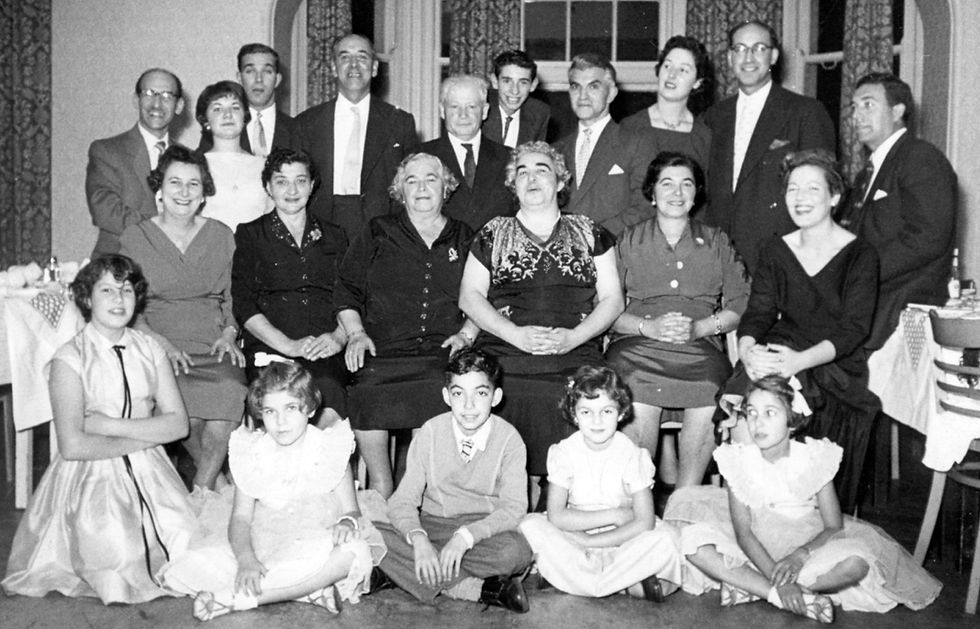
Late 1950s - A Schwartzman family get together at the Hotel Majestic, following Arnold's return from National Service.
Reproduced with the kind permission of Arnold Schwartzman
A Seaside Stage
For Arnold, Cliftonville in the 1950s was a stage of light and spectacle. By day, the promenade smelled of salt and tar; by evening, lamplighters moved along Lewis Crescent as posters advertised acts at the Winter Gardens and Lido.
Outside the hotel, Cliftonville and Margate itself offered an entire sensory world: the tang of seaweed beneath the pier, the shiver in the sand, the milky Turner light over the water, and the electric pings, bells, and shrieks of the penny arcades. At the bingo hall, barkers chanted out numbers over the crackle of microphones, adding to the carnival atmosphere that washed through the Queen’s Promenade.
The Majestic’s entrance displayed those posters, an arrangement that earned the family free tickets. Arnold saw Laurel and Hardy, Gracie Fields, and Tommy Cooper perform, memories that stayed with him for life.
In 1950, while playing on Walpole Bay beach, a film crew shooting The Weaker Sex spotted him and offered him a small role. He would later recall it as his first step toward cinema; the beginning of a creative journey that would carry him from Cliftonville to Hollywood.

Image of the Schwartzmans- owners of Rosanda and Majestic
Reproduced with the kind permission of Arnold Schwartzman

Naturally, at the age of 15, Arnold left school. His first job was as the assistant projectionist at the Cameo Cinema on Northdown Road, owned by Jack and Lily Hyman, members of the local Jewish community.
Arriving in Thanet and seeing the sea left Tony Graham “semi-ecstatic with anticipation.” For the children who stayed there, the Majestic itself offered endless entertainment. Tony remembered the pitch-and-putt on the green outside, and the excitement of the slot machines and horse-race games that required a threepenny piece. He recalled visiting the Bungalow café for Knickerbocker Glories, watching the Billy Cotton Band Show at the Winter Gardens, and excited journeys on a red bus to the Odeon for the latest film: “a world away from Comfortville”. His older brother remembered families gathering around the black-and-white television in the lounge of the Majestic to watch the Beatles’ earliest broadcasts, moments that fused the excitement of the 1960s with the atmosphere of Cliftonville.
Seasons and Change
At its height, the Majestic thrived. Guests returned year after year, bringing their ration books, which Rosie carefully logged. When rooms were full, David found overflow accommodation nearby. Each autumn, he took the hotel’s silverware to London to be replated at Mappin & Webb, a small ritual of professional pride.
The strictly kosher dining room lay at the heart of the hotel. Papa Savva, the Majestic’s Cypriot chef, was a gifted and colourful character who once showed Arnold a photograph of his ten brothers, all Greek Orthodox bishops. He added warmth and humour to the kitchen, embodying Cliftonville’s post-war mix of Jewish, Cypriot, and British workers. In the tense 1950s, as Cyprus sought independence, Special Branch officers occasionally visited, “to see if he was up to no good,” as Arnold joked.

Ration book linked to the Majestic Hotel.
Reproduced with the kind permission of Arnold Schwartzman

In 1961, Helen Shapiro, supported by new young band The Beatles, spent a week headlining the Margate Winter Gardens. Helen stayed at the Majestic, and is pictured here with Rosie Schwartzman.
Reproduced with the kind permission of Arnold Schwartzman
Among the Majestic’s regular guests was the mother of popular BBC bandleader Stanley Black, who sat in the lounge each week to listen proudly to her son’s broadcast. Visiting Winter Gardens entertainers such as Alma Cogan and Helen Shapiro brought a touch of glamour. Others, including caricaturist Ralph Sallon and famed graphic designer Abram Games, left a lasting mark on Arnold. Sallon, who drew for the Daily Mirror, took him to sketch the Labour Party Conference at the Winter Gardens. Games, creator of the Festival of Britain emblem, recognised Arnold’s potential and became his lifelong mentor.
Guests also remembered the lively social world that unfolded inside the hotel. Tony Graham recalled winning the Derby sweepstakes in the dining room, fancy-dress parties, the hokey-cokey, conga lines that wound through the corridors, and occasional piano-led dances in the basement ballroom beside the snooker room. One guest, known as Bunny, would sing old Yiddish songs, while larger-than-life characters like “Uncle” Bob Shafier led mischief and laughter. Together, these moments created what Tony called “a great party spirit that seemed to happen every day at the Majestic.”
It was this blend of family, artistry, and friendship that gave the Majestic its distinctive character, a hotel that felt as much like a salon as a boarding house, where conversations over dinner moved easily from synagogue talk to theatre gossip or the politics of design.
Storm and Memory
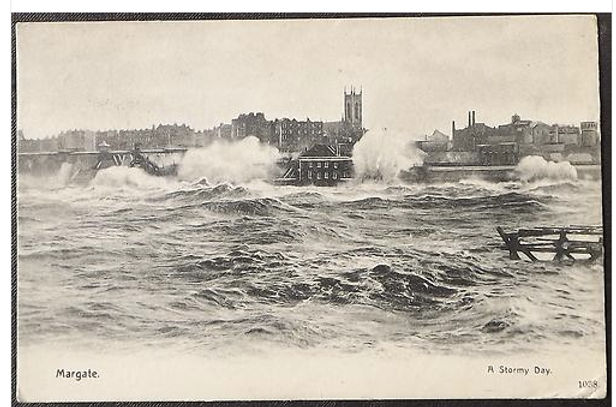
In February 1953, a violent storm struck the Kent coast. Arnold stood with his father on Fort Hill and watched the jetty buckle and the lighthouse collapse into the sea; an image that, for him, marked the end of Cliftonville’s grand hotel age. One by one, the great establishments vanished: the St George’s, the Norfolk, the Grand, and the Queen’s Highcliffe. Fires later destroyed the Endcliffe Hotel, where his father once held Masonic “Ladies’ Nights,” as well as the Bungalow Café and parts of the Lido. “The cruel sea,” Arnold wrote, “had ravaged the jetty, the lighthouse and the Lido.” Only the Walpole Bay and Nayland Rock still survive, relics of a vanished world.
By the early 1960s, cheap flights to Spain, Italy, and Israel were drawing visitors abroad. The Schwartzmans retired before the decline, turning down an offer from Billy Butlin to buy the property. The Majestic was later sold and converted into apartments, though its façade still faces the sea, a reminder of the family’s hospitality and its moment in the sun.
Afterglow
Rosie and David remained in Thanet after retirement, proud of what they had built. In 1980, Rosie travelled to Israel to visit her daughter Diana and died unexpectedly during the holiday. Unlike the many Jews flown to the Holy Land for burial at that time, Rosie’s journey went the other way: her body was flown back to England and laid to rest in the Hebrew Section of Margate Cemetery. David joined her there in 1987.
For Arnold, who went on to an international career as a designer and filmmaker, Margate remained the beginning of everything. In 1982, he won an Academy Award for Best Documentary Feature for Genocide, a film about the Holocaust and the endurance of the Jewish people. Yet he often traced his creative vision back to his childhood in the Majestic, the place where his parents rebuilt their lives from the ashes of war, where Jewish family life flourished by the sea, and where he first learned to see the world with an artist’s eye.
Writing later from Los Angeles, Arnold hoped Margate might “rise again like a phoenix from the ashes”, its promenade, bandstands, and hotels restored to the light of his memory. In 2023, Arnold was made an Honorary Freeman of Margate, and in 2024, the Schwartzman Gallery was named in his honour.
The Majestic is long gone, its rooms divided into apartments, but its story endures: a testament to immigrant families who turned survival into renewal and built their own kind of majesty beside the sea.

Arnold Schwartzman was made a freeman of Margate in 2023, pictured with his wife Isolde, former Mayor of Margate Rob Yates, and his friend, actor Ben Kingsley.
Reproduced with the kind permission of Arnold Schwartzman
© Katie Blythe 2026
Primary Sources & Further Reading
Cliftonville Nostalgia Facebook Group (2023–2024), public community posts and recollections relating to G’s Stores.
Gaffin, Jean (2022), oral history interview. Cliftonville Voices Oral History Project. Unpublished interview recording and transcript.
Gradus, Ruth (2025), correspondence with author and funeral speech for Geoffrey and Gerrie Gradus.
Hoser, Perrina (2022), oral history interview. Cliftonville Voices Oral History Project. Unpublished interview recording and transcript.
Hoser, Tania (2022), oral history interview. Cliftonville Voices Oral History Project. Unpublished interview recording and transcript.
Isle of Thanet Gazette (1994), “Leading Jew Benny Dies”, 17 June, p. 12.
Ruback, Ernestine (2021), oral history interview. Jewish History Thanet Project.
Ruback, Ernestine (2022), oral history interview. Cliftonville Voices Oral History Project. Unpublished interview recordings and transcripts.
Schwartzman, Arnold (2022), oral history interview. Cliftonville Voices Oral History Project. Unpublished interview recording and transcript.
Stock, Wayne (2024), personal recollections of employment at G’s Stores, 1974–1975. Written testimony and correspondence with Katie Blythe.