![Rowden Hall, corner of Lewis Crescent and lawns [possibly 1907?]](https://static.wixstatic.com/media/eaae9c_9daac73527bd41b0b720cea0716249d5~mv2.jpg/v1/fill/w_980,h_551,al_c,q_85,usm_0.66_1.00_0.01,enc_avif,quality_auto/eaae9c_9daac73527bd41b0b720cea0716249d5~mv2.jpg)
Rowden Hall
Lewis Crescent
How kosher margarine built a refuge for sixty Kindertransport boys.
Researched and Written by Katie Blythe
Rowden Hall
Rowden Hall stood on the corner of Lewis Crescent and First Avenue, overlooking the sea at Cliftonville, Margate. Built in the Edwardian period, the villa was once the seaside home of Jacob Van den Bergh (1848–1934), son of Simon Van den Bergh, who had founded one of the world’s first margarine factories in the Netherlands in 1872. Simon later produced Tomor, named from the Yiddish tamar (palm), the first widely available kosher margarine, advertised in 1908 as “The Most Perfect Kosher Substitute for Natural Butter.”
Margate's Margarine King
Jacob settled in England in the 1870s, became a naturalised citizen, and married Lydia Isaacson in 1871. After Lydia died in 1915, he married Annie Van Zwanenberg (née Corper), linking two major Dutch-Jewish industrial families. With four live-in servants, Rowden Hall served as the family’s seaside retreat and a model of Anglo-Jewish prosperity. Jacob supported the early Margate Hebrew Congregation, contributing anonymously to the building of the Godwin Road synagogue in 1919.

1934 Jacob Van Den Bergh
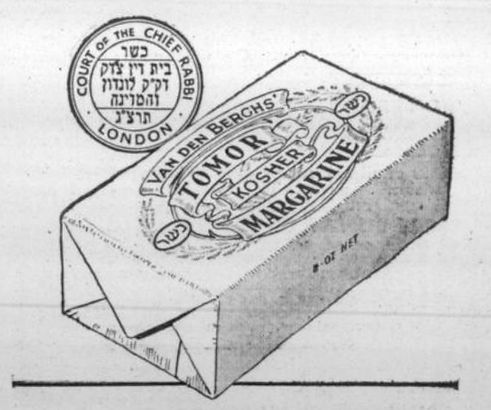
1933 Tomor Kosher Margarine advert
By the 1930s, Tomor was certified by the London Beth Din, becoming a practical staple of the modern Jewish household. Nicknamed “the Margarine King,” Jacob was celebrated in the Evening News as “the man who taught England to eat margarine.” His company became part of Van den Bergh Ltd, later absorbed by Unilever, while the family maintained close ties with Margate, which Jacob called “the finest place in Great Britain.” Jacob’s eldest son, Albert, chaired the company and aided local institutions such as the Royal Sea Bathing Hospital; another son, Sidney, later sold nearby land for the Palm Bay Estate, shaping Cliftonville’s landscape. His daughter Miriam had also married John Benjamin Sainsbury in 1896, uniting the Van den Bergh’s with one of England’s most enduring Jewish supermarket dynasties. Jacob himself died in Hampstead in 1934 and was buried beside Lydia in the Ramsgate Jewish Cemetery.
Welcoming The Stranger
Between December 1938 and September 1939, nearly 10,000 mostly Jewish children escaped Nazi-occupied Europe through the Kindertransport, organised by British and Jewish relief agencies after Kristallnacht (Pogrom night). Separated from their parents, they were placed in foster homes, schools, farms, or purpose-built hostels that provided education, language teaching, and continuity of Jewish life.
One such refuge was Rowden Hall School, established in early 1939 within the former Van den Bergh residence. Sponsored by B’nai B’rith (Sons of the Covenant), the international Jewish service organisation, it housed about 60 boys aged eight to sixteen from Germany and Austria.
The Thanet Advertiser reported that B’nai B’rith assumed full economic responsibility for the venture, around £3,500 per year, to be spent largely on local food, furnishings, and educational materials, while providing a modest boost to the local economy, without burdening ratepayers.
A local oversight committee connected the hostel with Margate’s Jewish community. Its members included Alexander Hershfeld (president), Rev. Moses Cohen (minister of the Margate Hebrew Congregation), Dr David Braham (vice-chairman and honorary medical officer), and Isaac Arone (chairman and honorary dental surgeon). Survivors later remembered them as “nice and decent people,” sometimes teased by the boys but respected for their generosity.

1908 Tomor Kosher Margarine advert
Crossing The Channel
The children typically arrived in Britain at Southampton or Harwich, having travelled from Germany or Austria on ships such as the SS Manhattan. For many, the voyage took three days, often via The Hague, and marked their first extended separation from family. Some were accompanied to the train station by parents they would never see again. For the youngest, the journey itself retained an element of wonder. Bernd Koschland, who was eight years old when he left Fürth, Bavaria, remembered the Kindertransport as a “big adventure.” The experience combined excitement, confusion, and grief; a collision of hope and dislocation that shaped their first impressions of safety in Britain.

A 1931 postcard advertising the luxury liner SS Manhattan.
For Bernd, the journey began in southern Germany. It continued to Hamburg, where children gathered with parents and relatives, “lots of people with mums and or dads or both,” waiting together before departure. He remembered being offered cocoa before boarding and embarking on what he recalled as “one of the trans Atlantic liners, the SS Manhattan.” His father did not accompany him, but his mother travelled with him to the port. As the ship set sail, she followed alongside in a small pleasure steamer, watching from the deck. “There was a picture which, unfortunately, time has lost,” he later reflected. “Sad that I haven’t got that photograph anymore, but there was the last vision I had of my mother.”
Even amid separation and loss, the voyage carried moments of childhood excitement. Bernd recalled that the children “had a jolly good time, probably annoying the other passengers on board,” running about the ship, pulling out drinking cups, and being told off. It was, he said, a “great adventure”, a fleeting sense of freedom that existed alongside the unspoken knowledge that nothing about their lives was ordinary any longer.

…there was a journey from Southern Germany to Hamburg… which was to be our point of departure, and where we assembled… lots of people with mums and/or dads or both. Being offered some cocoa… eventually embarking on what was then one of the trans-Atlantic liners, the SS Manhattan. My father didn’t come with. My mother… she accompanied me… There was a picture which, unfortunately, time has lost. And as the ship went out, she went on a small… pleasure steamer… watching from the boat garden… Sad that I haven’t [got] that photograph anymore, but there was the last vision I had of my mother…


… I think as kids, we had a jolly good time, probably annoying the other passengers on board… Great adventure, going wild on-board trip… being told off [for] pulling out the cups for water and things and having great fun.
- Bernd Koschland

Jewish children from the Rowden Hall School attend a Hannukah party in an overflow hostel on Harold Road. USHMM 24052-S
© United States Holocaust Memorial Museum

A 1929 photo of inside the Clifton Slipper Baths, later known as the Lido. © Margate Local History
Fried Fish & Milky Tea
The building was adapted to communal use with classrooms, a dining hall, and dormitories. Each room held rows of bunks, where the sea air rattled the cracked windows, allowing snow to drift inside during the winter months. Rather than being troubled by this, the boys made the most of the situation, engaging in lively snowball fights from one bed to another.
The boys wore matching uniforms and were told to speak English as much as possible. Meals were plain and English: fried fish, porridge, puddings, and endless tea. The first supper, remembered as “horrible,” soon became familiar, then monotonous. Boys received small allowances of two to four old pence per week; some saved for cinema outings or bought broken biscuits from Woolworth’s to supplement rations. The atmosphere was strict but safe, and for many, it was the first security they had known for months.
Bathing was another early and bewildering encounter with English life. Despite having arrived on a modern passenger ship, the boys were taken to the Slipper Baths at Cliftonville Lido. This communal bathhouse felt intimidating to children with little English and no familiarity with such systems. Hermann Hirschberger remembered being pushed into a cubicle where the water was turned on and off from outside with a large spanner. When he tested the bath, it was “scalding hot” and impossible to enter. Too timid to know what to do, and with his English “almost non-existent”, he listened as voices from neighbouring cubicles called out, “some more cold in number 64, please” and “could I have some more cold in 21, please”. Summoning his courage, he shouted for more cold water himself. The tap was briefly opened, then closed again, and the bath remained unusable. “That was my first bath in freedom, in England,” he later recalled, laughing at the absurdity and vulnerability of those first days.
Some children remembered the first nights vividly: the homesickness and uncertainty, the feeling of being safe but far from everything familiar. Yet within days, they began to settle into a new rhythm of schooling, synagogue, and seaside strolls, learning to make a kind of home at the edge of England.
English lessons began immediately. These were provided by Max Baer and Miss Giles, a local tutor, who taught basic phrases; her heavy makeup astonished the German boys, who were unused to such fashion. Within weeks, they attended local schools, notably St John’s Church School. Hirschberger, aged twelve, later recalled his bewilderment at lessons he could not follow, until the girls in his class unexpectedly elected him Vice-Captain of Kipling House, an act of kindness that transformed his confidence: “I must say, in a very sad story, I must forever be grateful to the girls of Margate…!”

1939 - Rowden Hall looking from Walpole Bay [Freddy Stern aJR]
Rowden Hall maintained an Orthodox Jewish atmosphere. Food was fully kosher; kippot were worn at meals and prayers. The boys attended services each Friday evening and Saturday morning at the Margate Hebrew Congregation synagogue, led by the “charming” Rev. Moses Cohen. The boys were marched down the road in columns of three, “…though not behind a swastika flag this time,” Steven Mendelsson recalled. “We must have looked so odd!” Candles, Kiddush, and song shaped Friday nights; “it felt,”remembered Freddy Stern, “like being back among our own people again.”
Bar Mitzvah preparation formed a central rite of passage. Hirschberger celebrated his in July 1939, alongside two other boys: “They made a party and tried their best.” Meanwhile, Steven Mendelsson, was told on arrival that his Bar Mitzvah would take place within two weeks. Such occasions offered joy amid separation from parents overseas.
Illnesses soon followed communal living. Freddy Stern contracted scarlet fever and was sent to the Thanet Isolation Hospital in Ramsgate; the hostel was quarantined, confining boys indoors for weeks. “It seemed to Freddy like he was held in isolation for a month, although it was probably less than a fortnight,” his memoir records. “It was incredibly boring, but it did wonders for developing his English language skills as no one there spoke German.” In his hospital bed, Freddy received a parcel from his parents in Germany: a box of chocolates. It would be one of the last times he heard from them before the war severed communication. By the time he returned to Rowden Hall, he found himself treated with wary sympathy. The quarantine had kept all the boys confined indoors, and none were allowed to leave the grounds until the infection had fully cleared.
A similar episode appeared in Herbert Heineman’s memoir, which described a separate mumps outbreak. “We were told to chew gum to make saliva flow,” he wrote, “and when done chewing, we’d throw the gum against the wall, where it stuck.”

Jewish children from the Rowden Hall School attend a Hannukah party in an overflow hostel on Harold Road. USHMM 24073
© United States Holocaust Memorial Museum
The warden, Mr Grossman, enforced order with severity. Hirschberger described him as “a nasty piece of work” who struck boys, confiscated food parcels, and manipulated pocket money payments to keep a portion for himself. After Hirschberger’s Bar Mitzvah, his parents managed a brief international phone call, the last time he would ever speak with them, cut short when Grossman seized the receiver to complain about his behaviour.
The matron, Ruth Katz, was similarly strict. Heineman recalled drawing flowers on a letter to his parents; the censor rejected it, suspecting a code, and the matron publicly mocked him, “so everyone could have a good laugh at my expense.” Her husband, Norbert Katz, helped manage the household, while Jana Politzer, the Polish-born cook, maintained kosher catering despite shortages, in collaboration with Leon Gradel of the Northumberland Hotel. Two teachers were selected from among the adult refugees at the nearby Richborough Kitchener Camp in Sandwich: David Rosenblueth, who served as a sports trainer, and Kurt Bergel, a liberal German Jewish scholar, who found the Orthodox environment professionally limiting.
Despite its institutional harshness, the structure offered some fragile stability. Days began with prayers, followed by lessons, chores, and evening curfews. Outdoor play, football on the lawns or along the promenade, was central to morale. The boys spoke mostly German among themselves, gradually mixing in new English words and phrases as time went on.

From Blackboards To Blackout Curtains
Although closely supervised, the children were not isolated from Margate’s community. Local teachers and neighbours showed small kindnesses. Heineman remembered the warmth of his teacher, Miss Hillyard, who treated him gently and helped him learn English. The Margate children, he said, “were kind to me. I felt like a pet. One girl even gave me chocolate.” These simple and unselfconscious gestures softened the strangeness of exile. Mendelsson quickly picked up English from his classmates, who mischievously taught him a few rude words that he cheerfully repeated to his, fortunately, very understanding, teachers.
On fine days, the boys walked into town or along the promenade in pairs, their matching uniforms drawing curious glances. They explored the sand at low tide and sometimes visited Dreamland, the local amusement park.

Erika Meyer visits her brother Gus in Margate. USHMM 32864-S
© United States Holocaust Memorial Museum

Jewish children from the Rowden Hall School attend a Hannukah party in an overflow hostel on Harold Road. [Image 2] USHMM 23974-S
© United States Holocaust Memorial Museum
…we were allowed to go into town, but on Saturdays and Sundays, we were confined to barracks… We were told that people who came down from London to relax didn’t want to be reminded of the terrible things happening on the Continent. Even at thirteen, that was very painful. Here we were. Those people who had given us a haven and literally saved our lives, yet they didn’t want to be reminded of what was happening to our parents and the Jewish people in general.
On 3rd September 1939, the boys gathered around the hostel’s wireless as Prime Minister Neville Chamberlain announced that Britain was at war with Germany. Some understood the meaning immediately; others, like the eight-year-old Bernd Koschland, recalled being “worried but not clear what it meant.” Air-raid precautions followed: blackout curtains, gas-mask drills, barbed wire and sandbags along the promenade. Max Bodenheimer remembered watching from the shore as ships burned and sank and hearing the sirens that warned of bombing raids. Rowden Hall’s windows cracked under the constant vibration of nearby explosions.
When the Dunkirk evacuation began in May 1940, the boys watched boats crowd the horizon and injured soldiers being brought ashore. Mendelsson described being assigned to a nurse and being equipped with thousands of cigarettes: “In those days, everybody smoked Woodbines; they came in small green packets, and my task was to light a cigarette and then put it into the mouth of the oncoming soldier.” “This was a very grim experience,” he recalled, describing “a beaten army”, “terribly bedraggled”, with head wounds and bandages, many needing help ashore. He remembered how “they took their steel helmets and their First World War rifles, Lee Enfields, threw those into the sea as a sign of disgust and total abjection.” For three days, he kept lighting cigarettes, until “the skin on my lips were very, very raw”, and he estimated he “must have got through easily 1,500 cigarettes or so”, jokily framed as “part of the war effort… we all had to make a sacrifice!”
Footage filmed in 1940 by the Southern Railway Film Unit of Operation Dynamo, the Dunkirk evacuation, including French troops waiting at Margate Railway Station.
© Imperial War Museum Non-Commerical License
![Rowden Hall, corner of Lewis Crescent and lawns [possibly 1907?]](https://static.wixstatic.com/media/eaae9c_e93404e62abd44eb83da2fe6f2ee0130~mv2.png/v1/fill/w_439,h_288,al_c,q_85,usm_0.66_1.00_0.01,enc_avif,quality_auto/1907---Lewis-Crescent-and-lawns-Rowden-Hall.png)
1907 - Lewis Crescent and lawns Rowden Hall
© Margate Local History
By summer 1940, the Kent coast was declared a restricted military zone. Rowden Hall was ordered closed, and the boys were evacuated inland; some to Tylers Green Hostel in Buckinghamshire, others to smaller homes across the Midlands and North. The great Edwardian villa was shuttered and boarded. Its time as a refuge was over.

The Town and the War: Margate, 1939-1940
Although closely supervised, the children were not isolated from Margate’s community. Local teachers and neighbours showed small kindnesses: Herbert Heineman remembered the warmth of his teacher, Miss Hillyard, who treated him gently and helped him learn English. The Margate children, he said, “were kind to me. I felt like a pet. One girl even gave me chocolate.” Such gestures, simple and unselfconscious, softened the strangeness of exile. Steven Mendelsson quickly picked up English from his classmates, who mischievously taught him a few rude words that he cheerfully repeated to his, fortunately, very understanding, teachers.
On fine days, the boys walked into town or along the promenade in pairs, their matching uniforms drawing curious glances. They explored the sand at low tide and sometimes visited Dreamland, the local amusement park.
Dispersal
The boys left Margate under blackout, uncertain of their destination. Letters to Germany had already ceased once the war began, and few yet realised that separation from their parents would be permanent. Of the 10,000 Kindertransport children who reached Britain, only about one in ten was reunited with their families after the war.
Among the Rowden Hall group, most learned later that their parents had perished in concentration camps. Hermann Hirschberger and Bernd Koschland both discovered that their families were murdered at Auschwitz. Some of the boys eventually emigrated to the United States, with Freddy Stern, who remained in England, later describing Rowden Hall as “the last place I was a child.”

Group portrait of the members of the soccer team of the Rowden Hall School in Margate. USHMM 24080
© United States Holocaust Memorial Museum
Only Steven Mendelsson and his brother were exceptions. Mendelsson later spoke of what he called an “absolute miracle.”
By the grace of God, my parents reached the shores; they reached Britain 36 hours before Chamberlain declared war.
Germany had already invaded Poland, yet somehow, he recalled,
they managed to get out into England before the war started.
With help from relatives, his parents rented a small flat in Margate so they could remain close to their sons. His mother mended clothes at the hostel, and his father occasionally acted as deputy headmaster. “We were the only children among the sixty who had this terrifically fortunate situation,” Mendelsson remembered, fully aware of how rare it was. “The vast majority of parents of those at Rowden Hall ultimately died in concentration camps.”
One of his friends was not so lucky. The boy’s parents had sailed legally from Hamburg to Southampton aboard a German ship in late August 1939. When Chamberlain declared war, the ship was ordered to turn back. “Some 800 people on board,” Mendelsson recalled, “were all eliminated within a very short time.”
For the Rowden Hall boys, the sea that had provided their rescue was now a boundary marking separation. In later decades, some met again in London synagogues or at refugee reunions, carrying both gratitude and sorrow. As one survivor later wrote, they were “the lucky ones who lived to remember.”


1938 Freddy Stern travel document photo
What Happened Next: The Boys of Rowden Hall
Alfred (Freddy) Stern (1925–2020)
Born in Montabaur, Germany, Freddy escaped on the Kindertransport and later became an industrialist in Newcastle upon Tyne, founding General Foam Products, a major supplier to Britain’s car and furniture industries.
Herbert Kohn (1926–2020)
Frankfurt-born Herbert emigrated to the United States in 1940, became a successful business executive and used his own experiences to become a pro-Black civic rights leader in Atlanta, dedicating his later years to Holocaust education.
Hermann Hirschberger, MBE (1926–2020)
From Karlsruhe, Hermann became an engineer and campaigner for Kindertransport refugees, helping to create Making New Lives in Britain and receiving the MBE for his work in Holocaust remembrance
.
Max Bodenheimer (1926–2012)
German-born Max emigrated to the United States, built a career in academia and Jewish communal life, and often described his early months in England as his first experience of true freedom.
Steven Mendelsson (1926–2013)
After escaping Nazi Germany with his brother, Steven became an engineer and management consultant, later lecturing in Sheffield and speaking widely about the Kindertransport.
Wolfgang Walter Mendelsson (1930–2000)
The younger brother of Steven, Wolfgang became a leading scholar of commemorative memorial brasses, serving as Honorary Secretary of the Monumental Brass Society from 1974 to 1994 and later as Life Vice-President.
Herbert Heineman (1930–2021)
A refugee from Krefeld, Herbert became a physician and Laboratory Director for the Philadelphia Health Department, writing memoirs and fiction inspired by his wartime experiences.
Rev. Bernd Koschland, MBE (b. 1931)
Born in Fürth, Bavaria, Bernd became a rabbi, educator, and Holocaust advocate, serving London congregations and receiving the MBE in 2018 for his contribution to Holocaust and interfaith education.
© Katie Blythe 2026
Primary Sources & Further Reading
AJR Refugee Voices Oral History Project
Alfred (“Freddy”) Stern, interview conducted by Dr Bea Lewkowicz, 4 July 2017.
Bergel Kurt, interview conducted by Robert Clary, 27 December 1995. Interview 10571. Available at: https://vha-usc-edu/testimony/10571
Bodenheimer Max, interview conducted by Leora Saposnik, 26 March 1996. Interview 11739. Available at: https://vha-usc-edu/testimony/11739
Census of England & Wales (1911), 13 Lewis Crescent, Margate, St John the Baptist, Kent.
Census of England & Wales (1921), 13 Lewis Crescent, Margate.
East Kent Times (24 December 1938), “Thanet Succour for Refugees,” p. 7.
East Kent Times (25 January 1939), “Younger ones will remain at the hostel for three years…” (Rowden Hall Boys’ Hostel).
Evening News (London) (14 April 1934), “He Taught England to Eat Margarine.”
Heineman Herbert, A Pilgrimage (2011).
Herne Bay Press (31 December 1938), “Jewish Refugees in Thanet,” p. 7.
Hesped.org (2020), Obituary of Alfred (Freddy) Stern.
Hirschberger Hermann, Jewish Chronicle obituary, 17 June 2020.
Hirschberger Hermann, interview conducted by Bernice Krantz, 20 March 1996. Interview 12417. Available at:https://vha.usc.edu/testimony/12417
Imperial War Museums, UK Holocaust Map, “Rowden Hall Boys’ Hostel”.
Jewish Chronicle (25 September 1908), Tomor advertisement, p. 6.
Jewish Chronicle (7 April 1933), Tomor advertisement, p. 19.
Jewish Chronicle (9 August 1935), “Rowden Hall, Cliftonville: Auction Notice by Reeve & Bayly,” p. 45.
Jewish Chronicle (9 August 1935), “Re Lydia Van den Bergh, Deed: Sale of Rowden Hall,” p. 51.
JewishGen, Minister Profiles: Rev. Bernd Koschland, MBE.
Kelly, Benedict and Tripp, Gerald (2016), Ramsgate Jewish Cemeteries 1872–2016: Burial Register, Maps, Monumental Inscriptions and Selected Obituaries.
Kohn Herbert, survivor biography. Atlanta Holocaust Education Center.
Koschland Bernd, Rev. Bernd Koschland – My Story. Association of Jewish Refugees My Story Project.
Koschland, B. (2007), “Kindertransport: Tylers Green Hostel for young Jewish refugees,” Jewish Historical Studies, 41, pp. 271–290.
Mendelsson Steven, Holocaust Memorial Day Derby profile.
Mendelsson Steven, interview conducted by Dr Rosalyn Livshin, 15 September 2005.
Mendelsson Steven, interview conducted by Madeleine Kingsley, 7 February 1997. Interview 27340. Available at: https://vha-usc-edu/testimony/27340
Neue Rhein Zeitung (25 June 2009), Petra Herzog, “Mit Margarine missioniert [Missionised with Margarine].”
Owen Janet (21 December 2020), “Rowden Hall: A Place of Refuge,” The Earth Museum.
Sainsbury Archive, particularly related to Miriam Mabel Sainsbury nee Van den Bergh.
Sunday Express (15 April 1934), “This Man Changed the World’s Food.”
Thanet Advertiser (27 January 1939), “Refugee Hostel to be Established at Margate,” p. 10.
Thanet Advertiser (14 February 1939), “Jewish Refugee Home to Open at Margate,” p. 8.
Transactions of the Monumental Brass Society (2000–2001), Vol. XVI, Part 4, pp. 453–456, “Obituary: Walter Mendelsson, F.S.A.”
USC Shoah Foundation Visual History Archive
Bernd Koschland, interview conducted by Bernice Krantz, 17 September 1996. Interview 19915.
Wikipedia, “Simon van den Bergh”.